Common Coquina

2


Some of the shells featured in this photograph (flat edge) may be the Common Coquina, Donax variabilis measuring .5 to .75", and found from Virginia to South Florida, to Texas.

The two rounded edge shells, are unclear in identification, but may be the Atlantic Surf Clam, located throughout the Eastern U.S., and measuring up to 7" or, they may be the shell classed under Tellins and Semeles, as "Alternate Tellin", Tellina Alternata, which measures 2-3" and found from North Carolina through Florida to the Gulf Coast.

---

Classed under Bivalves
Clam-shaped - coquinas (Donacidae)
Variable coquina Donax variabilis (Say (=D. rœmeri protracta Conrad)
Description: (1 inch) Small, elongate, triangular shell. Smooth exterior with ribbing at beak end of shells. Hinge teeth.
Color: Extremely variable coloration -- white, yellow, orange, pink, red and purple in solids, ringed or rayed patterns.
Habitat: Lives in the intertidal zone of sandy ocean beaches.
Range: New York to Texas.
Notes: Also called a Florida coquina, butterfly shell, wedge shell or pompano. Often seen along the tide line of sandy beaches, where waves continually uncover these shallowly buried clams and wash them farther up the beach. Each time the coquina is exposed, its small, muscular foot immediately emerges and stands the animal on end as it burrows down an inch or two into the wet sand. Coquinas can survive in dry sand for up to three days. They make a delicious broth.
Source: Seashells of North Carolina, North Carolina Sea Grant College Program
Read More »

Turkey Wing - Ark Shells

0

I am not certain, but piecing together the information from two shell identification books, this shell may be called "Turkey Wing" and classed among Ark Shells.

Any further helpful identification would be appreciated.

The turkey wing (Arca zebra) is also called a zebra ark; it's found from NC to Brazil.
Terri K. Hathaway
Marine Education Specialist
North Carolina Sea Grant
http://www.ncseagrant.org/


Classed under Bivalves
Ark-Shaped - arks (Arcidae)
Turkey Wing Arca zebra (Swainson)
Description: (3.5 inches) Elongate shell. Ribs at rear not beaded. Straight hinge line with many small, chevron-shaped teeth. Resembles mossy ark except bottom edge neither crenulated nor strongly concave. Live specimens often covered by a shaggy periostracum and/or encrusting organisms.
Color: Yellowish white or yellowish brown exterior with reddish brown zebra-stripe markings. Whitish to pale lavender interior.
Habitat: Attaches to shells or rocks on offshore fishing grounds or near-shore hard surfaces. Commonly found on ocean beaches.
Range: North Carolina to Brazil.
Notes: Also called a zebra ark. It attaches to objects by a byssus and is often difficult to see because of encrusting growths. Abbott (1974) reports it is served in Bermuda as part of a baked pie.
Source: Seashells of North Carolina, North Carolina Sea Grant College Program
Read More »

Some Common Coastal NC Species

Alternate Tellin
Alternate Tellin
, Tellina Alternata (Say)

Angelwing
Angelwing
, Cyrtopleura costata (Linnaeus)

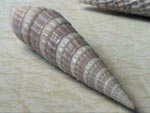
Atlantic Auger
Atlantic or Eastern Auger
, Terebra dislocata (Say)

Atlantic calico scallop
, Argopecten gibbus (Linnaeus)

Common Nutmeg
Common Nutmeg
, Cancellaria reticulata (Linnaeus)

Cross Barred Venus
Cross Barred Venus
, Chione cancellata (Linnaeus)

Angelwing
Fallen Angelwing
, Atlantic Mud Piddock, Barnea truncata (Say)

Angelwing
False Angelwing
, Petricola pholadiformis (Lamarck)

Humphrey Wentletrap
Humphrey Wentletrap
, Epitonium humphreysii (Kiener)

Imperial Venus Clam
Imperial Venus
, Chione latilirata (Conrad)

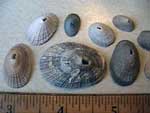
Keyhole Limpet
Cayenne keyhole limpet
, Diodora cayenensis (Larmarck)

Keyhole Sand Dollar
Keyhole Sand Dollar
, Mellita quiquiesperforata (Leske, 1778)

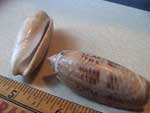
Lettered Olive
Lettered Olive
, Oliva sayana (Ravenel)